Introduction: The Anatomy of a $100,000 Invoice
Imagine your digital agency closes a $100,000 retainer with an enterprise client in the United States or the UAE. Your team delivers exceptional work, the client approves the invoice, and their accounts payable department initiates a standard SWIFT wire transfer.
Five business days later, you check your company bank balance.
Instead of $100,000, you find $96,150.
Where did the remaining $3,850 vanish?
It didn’t disappear due to project scope creep or late payment penalties. It was quietly siphoned off by legacy banking architecture: an opaque foreign exchange (FX) spread, intermediary routing fees, and forced currency conversions.
For scaling creative, software development, performance marketing, and remote staffing agencies, this is not an isolated incident—it is a recurring monthly tax. If your agency bills $1.5M to $3M annually from overseas clients, you are quietly handing $60,000 to $120,000 of pure net profit to correspondent banks every single year.
In this operational playbook, we break down the exact mathematics behind these hidden margin leaks and outline how top-performing global agencies are rebuilding their financial stacks around modern, unified multi-currency infrastructure.
Part 1: The 3 Hidden Leaks Draining Agency Margins
Traditional retail and commercial banks were built for local, domestic commerce. When applied to modern cross-border agencies managing global clients and distributed talent, their infrastructure breaks down into three costly friction points:
1. The “Invisible” FX Spread (Loss: 2.5% – 4.0%)
Most agency owners believe bank wire fees are limited to the flat $25 or $45 fee stated on their account statement.
The real margin killer is the foreign exchange markup.
Traditional banks rarely execute currency conversions at the real, interbank mid-market rate. Instead, they mark up the exchange rate by 2.5% to 4.2% above the true market price. When an overseas client sends USD to an agency bank account denominated in EUR, GBP, or AED, the receiving bank automatically force-converts the entire amount at their retail rate before depositing the funds.
On a $50,000 invoice, a 3% hidden spread costs your business $1,500 in pure margin on a single transaction.
2. The Intermediary Correspondent Chain (Loss: $35 – $75 per wire)
The legacy SWIFT network operates like a flight itinerary with multiple layovers. Because your local bank rarely holds a direct relationship with your client’s overseas bank, the payment must hop through 2 to 3 intermediary correspondent banks.
Each intermediary bank deducts a processing fee directly from the principal amount without providing transparency or itemized receipts. The result? Your client insists they sent the full amount, but your balance arrives short—triggering awkward invoice reconciliation emails between finance departments.
3. The 4-Day Working Capital Freeze
Cross-border wires frequently take 3 to 5 business days to settle. During this transit window, your capital is locked in clearing-house limbo.
For agencies operating on tight payroll schedules—where media buying budgets must be funded daily and remote contractors expect payment every Friday—this settlement delay restricts cash flow velocity and forces agencies to maintain expensive cash buffers.
Part 2: The Distributed Contractor Payroll Nightmare
The margin leak doesn’t stop at client collections. Once funds finally land, modern agencies face the second half of the cross-border gauntlet: paying international talent.
Modern agency teams are rarely confined to a single city. A performance marketing agency based in Dubai or London might employ:
- 12 developers in Eastern Europe and Egypt
- 8 media buyers in Latin America
- 6 UI/UX designers in Southeast Asia
Executing payroll across this distributed roster under traditional banking rails creates an operational nightmare:
- Manual Entry Fatigue: Finance managers spend 4 to 6 hours every pay cycle manually inputting individual IBANs, SWIFT codes, and recipient addresses into traditional banking portals.
- Double Conversion Penalties: Funds converted from USD into local agency currency are then converted againinto contractors’ local currencies—subjecting the agency to a second layer of FX markups.
- Delayed Payouts: Freelancers frequently experience unexpected holds or rejections by local receiving banks, leading to team frustration and administrative firefighting.
Part 3: The 4 Rules of the Modern Cross-Border Agency Stack
High-growth agencies that protect their profit margins have abandoned disconnected legacy banks. Instead, they operate through a unified financial operating layer.
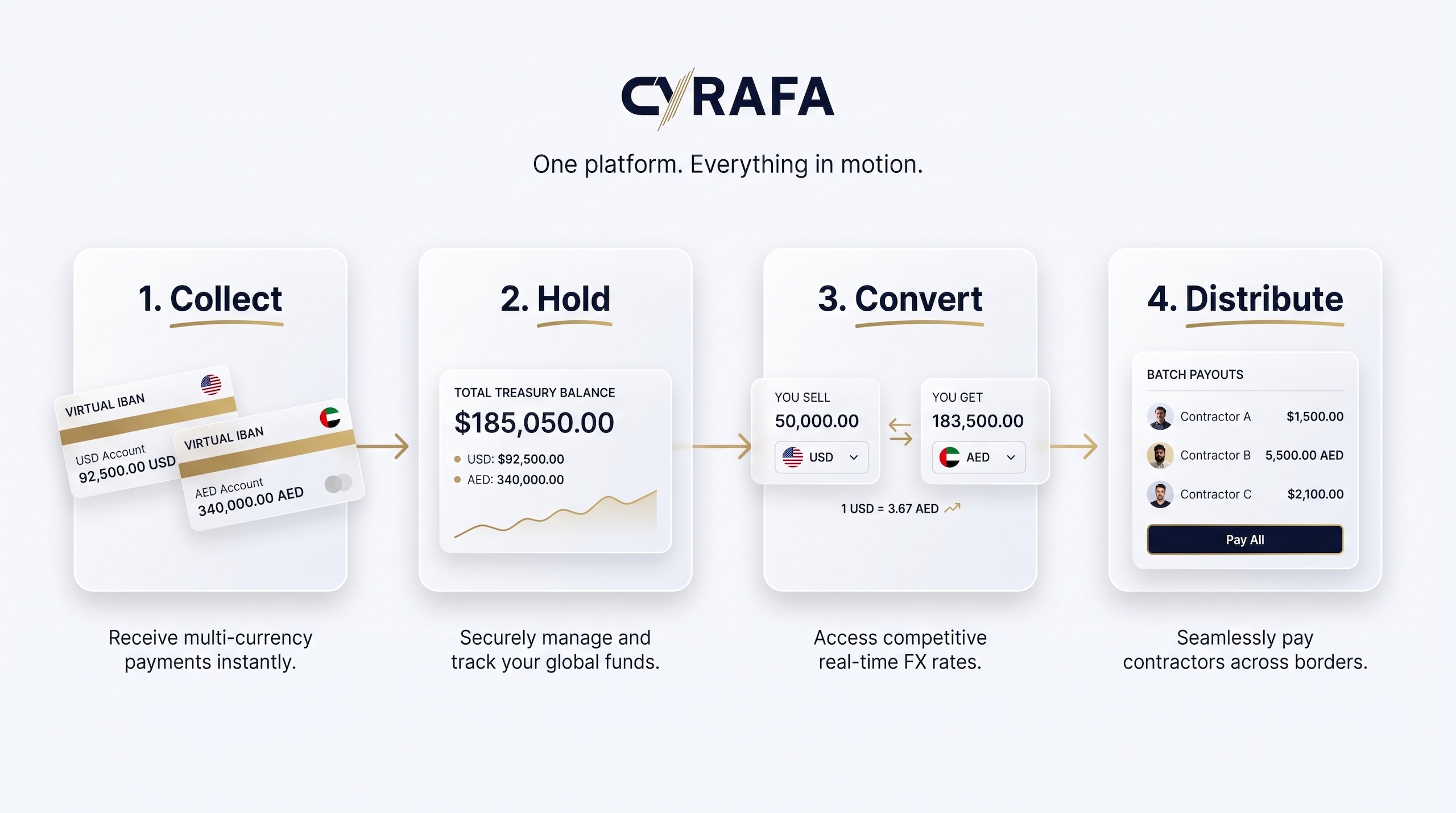
Here are the 4 fundamental rules of modern agency finance:
Rule 1: Never Force-Convert Client Retainers
Never allow a bank to automatically convert incoming foreign payments.
With Cyrafa Business Accounts, your agency receives dedicated multi-currency accounts and virtual IBANs in key commercial currencies—including USD, EUR, and AED.
When an American client pays you $30,000, you receive $30,000 in your USD balance. When a GCC client settles an AED 100,000 contract, it lands directly in your AED account. You maintain complete control over when, how, and how much currency to convert.
Rule 2: Eliminate the Middleman via Direct Routing
By utilizing modern settlement rails and regulated infrastructure, payments move through direct clearing paths rather than labyrinthine correspondent chains. Invoices arrive in full, eliminating reconciliation discrepancies and unnecessary third-party deductions.
Rule 3: Automate Contractor Payroll with 1-Click Batch Payouts
Instead of paying 30 contractors individually, modern agencies upload a single CSV file or trigger a payout workflow:
- Select recipient currencies (local fiat or stablecoins like USDT).
- Review clear, upfront exchange rates.
- Slide to transfer and settle all payouts simultaneously in minutes.
What previously consumed half a business day of manual data entry is reduced to a 120-second operational routine.
Rule 4: Consolidate Treasury into One Operating Layer
When client collections, multi-currency balances, FX conversions, and outgoing contractor payouts live inside a single dashboard, the CFO gains real-time visibility over cash runway, pending receivables, and net operating margins.
Part 4: Real-World Economics: Legacy Bank vs. Cyrafa
To illustrate the bottom-line difference, consider an agency with $60,000 in monthly international collections and $30,000 in monthly remote contractor payouts:
| Operational Metric | Legacy Banking Rail | Cyrafa Unified Operating Layer | Monthly Agency Savings |
|---|---|---|---|
| Incoming Wire Fees | $45 – $70 per wire | Transparent, minimal inbound | +$150 / mo |
| Client FX Conversion (3.2%) | -$1,920 on $60k volume | Transparent wholesale spread (0.3%) | +$1,740 / mo |
| Contractor Payroll Fees (25 Wires) | $35 x 25 = $875 | 1-Click batch payout rail | +$650 / mo |
| Settlement Velocity | 3 to 5 business days | Instant / Same-day settlement | Cash Flow Velocity |
| Finance Team Hours Spent | 16 hours / month | Under 1 hour / month | 15 Hours Saved |
| Annual Financial Impact | Total Leak: $35,000+ / yr | Retained Margin: Direct Net Profit | +$30,480 / year |
Part 5: Institutional Trust & Regulatory Security
When choosing an operating layer for your agency’s working capital, compliance and fund safety are non-negotiable.
Cyrafa LLC is registered with the U.S. Department of the Treasury Financial Crimes Enforcement Network (FinCEN) as a Money Services Business (MSB), Registration No. 31000307129357.
All account, payment, and settlement workflows operate under approved compliance, anti-money laundering (AML), and know-your-business (KYB) frameworks designed specifically for cross-border enterprise operations.
Conclusion: Move Money Without Complexity
In a competitive market where digital agencies compete on innovation, quality, and margins, losing 4% of your top-line revenue to legacy banking friction is a handicap your business cannot afford.
Your clients are global. Your talent is global. Your financial stack should be too.
One platform. Everything in motion.
Ready to eliminate cross-border friction?
- Open your Cyrafa Business Account: merchant.cyrafa.com
- Speak with our operations team: Book a 15-Minute Strategy Call
Leave a Reply